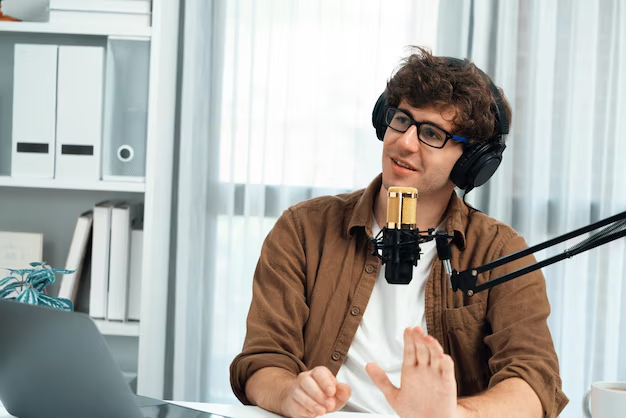
Podcasts went from a niche hobby to a genuine mass-media force in roughly two decades. Today, people listen to them during commutes, workouts, and household chores — and major news organizations, celebrities, and independent creators all treat the format seriously. Understanding how that happened means looking at the technology, the culture, and the business forces that all converged at the right time.
A podcast is an on-demand audio program distributed over the internet, typically as a series of episodes. Unlike live radio, listeners choose what to hear and when. Unlike a single audio file, podcasts are usually subscription-based in a loose sense — listeners "follow" or "subscribe" in an app, and new episodes are automatically delivered.
The technical backbone is RSS (Really Simple Syndication), an open web standard that lets creators publish audio files and lets apps retrieve them. That open infrastructure is one reason podcasting grew the way it did — anyone with a microphone and hosting could publish, and any app could aggregate shows without asking permission from a central gatekeeper.
The word "podcast" blends "iPod" and "broadcast," a label popularized by journalist Ben Hammersley in a 2004 article. But the underlying concept — downloadable audio programs delivered via RSS — was pioneered by technologist Dave Winer and broadcaster Adam Curry around the same time.
The early timing matters for a few reasons:
Apple added native podcast support to iTunes in 2005, giving the format its first mainstream distribution channel. That single move exposed podcasts to millions of people who had never sought them out.
For nearly a decade after 2005, podcasting remained a cult medium. The audience was real but relatively small, and monetization was primitive. Several friction points kept it niche:
Dedicated communities formed around technology, comedy, and storytelling shows, but mainstream culture hadn't arrived.
Two things cracked podcasting open around 2014–2015:
1. Serial. The true-crime investigative series from This American Life producer Sarah Koenig became a cultural phenomenon. It wasn't just popular — it was discussed. People who had never listened to a podcast downloaded it because colleagues and friends wouldn't stop talking about it. Serial demonstrated that podcasts could generate water-cooler moments the way prestige TV did.
2. The smartphone as default listening device. As smartphones replaced iPods and syncing gave way to streaming, the friction nearly disappeared. Apps like Overcast, Pocket Casts, and eventually Spotify made finding and playing a podcast as easy as playing a song.
Together, these forces moved podcasting from "thing tech people do" to something genuinely general-audience.
Early podcasts were largely passion projects funded by listener donations or small host-read ads. The business landscape shifted as the audience scaled.
| Era | Primary Revenue Model | Key Characteristic |
|---|---|---|
| 2004–2012 | Listener donations, small sponsorships | Creator-driven, minimal infrastructure |
| 2013–2018 | Host-read advertising, CPM-based ads | Mid-roll ads became standard; networks formed |
| 2019–present | Platform deals, subscription tiers, live events | Major media investment; exclusives emerge |
Host-read advertising became the format's signature monetization approach — an ad read by the host in their own voice, woven into the episode. Research has consistently suggested listeners tolerate these at higher rates than pre-roll digital ads, making podcasts attractive to direct-response advertisers even with smaller audiences than broadcast radio.
The later era brought platform investment. Spotify spent heavily acquiring podcast studios and exclusive shows. iHeartMedia, Amazon, and Apple all moved to stake positions. This institutionalized what had been a scrappy ecosystem — for better and worse, depending on who you ask.
Technology and business explain the growth, but they don't fully explain why people love podcasts. A few cultural factors do:
Intimacy of voice. Hearing someone speak directly into your ears for an hour creates a sense of connection that text and even video often don't. Regular listeners frequently describe hosts as feeling like friends — a phenomenon researchers have called parasocial relationships. That intimacy translates to trust, which is part of why host-read ads work.
The long-form revival. While social media compressed attention spans in one direction, a significant audience pushed back — craving depth, narrative, and extended conversation. Podcasts filled that space at a moment when long-form journalism was contracting.
Consumption during dead time. Audio is uniquely compatible with activities that occupy the body but leave the mind free — commuting, exercising, cooking, cleaning. Podcasts colonized time that no other medium could reach as effectively.
Low barrier to entry for creators. Because the infrastructure is open and recording equipment became affordable, the sheer diversity of topics exploded. Whatever a person's interest — obscure history, niche sports, regional cooking, minority languages — there's almost certainly a podcast serving it. That long tail of content created communities that larger media had never bothered to reach.
The medium has diversified well beyond its early talk-show roots.
Each format attracts different audiences and supports different business models. A daily five-minute news briefing and a three-hour weekly conversation show are both "podcasts," but they serve completely different listener habits.
Podcasting's maturity hasn't resolved every challenge:
Discoverability is still imperfect. The format has never developed recommendation infrastructure as powerful as what streaming music or video services offer. Word of mouth and social media clips remain the primary engines of show growth.
Measurement has improved but lacks the standardization of broadcast metrics. Advertisers still work with download and listener estimates rather than verified figures.
The open vs. closed tension continues. The original RSS-based ecosystem was fully open — any app, any creator. As major platforms have pushed exclusive content and proprietary apps, that openness has partially eroded. Whether podcasting retains its independent character or consolidates further into a few dominant platforms is genuinely unclear.
Podcasting's rise wasn't an accident or a single breakthrough moment. It was a slow accumulation of enabling conditions — the right technology arriving in the right order, a culture ready for long-form audio, business models that could sustain independent creators, and a handful of breakout moments that introduced the format to people who hadn't found it yet.
Whether you're a listener trying to understand why your feed is suddenly full of podcast recommendations, a creator thinking about entering the space, or someone watching media industry trends, the same underlying dynamics still apply: open distribution lowers barriers, intimacy drives loyalty, and the ability to reach niche audiences at scale is something podcasting does better than almost any format that came before it.