Elections are the formal mechanism through which citizens in democratic systems choose their representatives, leaders, and — in some cases — decide policy questions directly. They sit at the center of political life, but understanding how elections actually function requires going well beyond the basics. The rules, structures, and social forces surrounding elections vary enormously across countries, levels of government, and historical moments — and those differences have real consequences for who participates, who wins, and what outcomes follow.
This page is the starting point for anyone who wants to understand elections seriously: how they're designed, what research shows about how they work in practice, and what factors make the difference between comparable systems producing very different results.
Within the broader study of politics, elections represent one specific domain: the competitive, rule-governed processes through which political power is formally transferred or renewed. That distinguishes them from other political topics like policy analysis, legislative procedure, or political philosophy — though elections connect to all of those.
Elections scholarship draws on political science, sociology, economics, psychology, and history. Researchers study everything from ballot design to voter psychology to campaign finance to how electoral rules shape party systems. The field is large, and no single framework explains everything. That matters when evaluating claims about elections — the strength of evidence varies significantly depending on what question is being asked and how it has been studied.
Every election operates within a set of rules — collectively called an electoral system — that determines who can vote, how votes are cast, and how votes are converted into outcomes. These rules are not neutral. Political scientists have documented extensively how different electoral designs produce systematically different outcomes, and this is one of the better-established areas of elections research.
The most fundamental distinction is between majoritarian systems and proportional representation systems:
| System Type | Core Logic | Common Outcomes (General Findings) |
|---|---|---|
| First-past-the-post (FPTP) | Candidate with most votes wins the seat | Tends to produce two-party systems; can produce large seat majorities from modest vote shares |
| Ranked-choice voting (RCV) | Voters rank preferences; redistributed until majority achieved | Can reduce "spoiler" effects; evidence on downstream effects is still developing |
| Proportional representation (PR) | Seats allocated to match vote share | Tends to produce multiparty systems and coalition governments |
| Mixed systems | Combine elements of FPTP and PR | Outcomes vary significantly by design specifics |
These are general patterns observed across many democracies over time — they describe tendencies, not guarantees. How any specific election unfolds depends on the particular rules in place, the political culture, and many other factors.
Beyond the vote-counting mechanism, electoral systems also define district boundaries, ballot access rules, campaign finance regulations, voter eligibility, and election administration structures. Each of these is its own area of research and debate, and changes to any one of them can meaningfully shift who participates and what outcomes are possible.
Voter turnout — the share of eligible citizens who actually cast a ballot — is one of the most studied questions in political science. Research consistently identifies several factors associated with higher or lower participation, though the relative weight of each factor is still debated:
Registration requirements have been shown in multiple studies to affect turnout, with automatic or same-day registration associated with higher participation rates compared to systems requiring advance registration. The size of that effect varies across studies and contexts.
Socioeconomic factors show persistent correlations with turnout in research across many countries: higher income, higher education, and older age are generally associated with higher voting rates. These are observational patterns — they describe what tends to happen, not why in any individual case.
Electoral competitiveness is also consistently linked to turnout. Closer elections typically see more participation than foregone conclusions, a finding that holds across many different research designs.
Mobilization and social norms play a role that researchers have examined through field experiments as well as observational data. Being contacted by campaigns, having voting-normative social networks, and perceiving voting as a civic duty are all associated with higher turnout — though the magnitude of each effect varies.
What motivates any individual voter involves a combination of these structural factors and personal circumstances that research, by design, can only address in aggregate.
Electoral campaigns are the organized efforts by candidates, parties, and outside groups to win votes. Campaign strategy, messaging, ground operations, advertising, and fundraising are all subject to research — and the findings are more nuanced than popular coverage often suggests.
Studies on the effectiveness of campaign advertising, for example, generally find modest and often short-lived persuasion effects — particularly in high-information environments where voters already have strong predispositions. Ground-level canvassing and voter contact have shown more durable effects in some experimental studies, though results vary. The honest summary of the research is that campaigns matter at the margins in many elections — but margins can be decisive.
Campaign finance is a distinct and contested area. Research has examined the relationship between money and electoral outcomes, but causality is genuinely difficult to establish: candidates who are likely to win also tend to attract more donations. The influence of money on post-election behavior and policy is a separate, actively researched question with a complex evidence base.
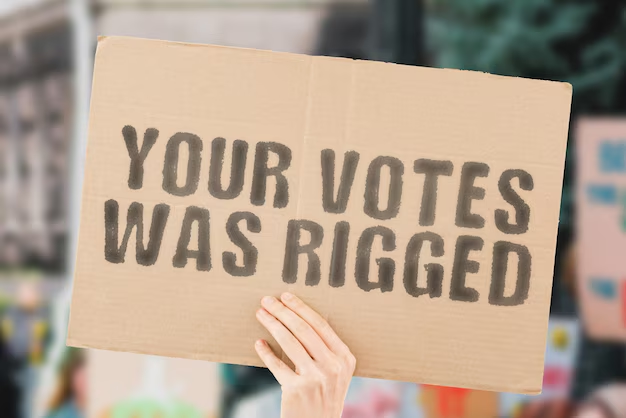
Election integrity refers to whether elections are conducted fairly, securely, and in a way that produces results reflecting voters' choices. This is both a technical and a political topic, and it's important to distinguish between the two.
On the technical side, election administration involves voter rolls, ballot design, voting technology, chain of custody for ballots, and the counting process. Electoral administration research has documented where vulnerabilities exist, where reforms have improved reliability, and where tradeoffs arise — for example, between security measures and voter access.
On the political side, election legitimacy — whether losing candidates and their supporters accept results — involves factors that go well beyond technical administration. Research on democratic backsliding has highlighted how contested legitimacy, even when elections are technically sound, can have serious long-term consequences for democratic systems.
These two dimensions are often conflated in public debate, which makes careful reading of claims about any specific election important.
One of the clearest lessons from comparative elections research is that context shapes everything. An understanding of elections in one country, or at one level of government, doesn't automatically transfer elsewhere. Some dimensions where variance is substantial:
Level of government matters considerably. Presidential elections, legislative elections, local elections, and ballot measures operate under different rules, involve different voter populations, and show different patterns of competition and turnout. Local elections in particular tend to show dramatically lower turnout than national ones, a gap that has been studied in multiple contexts.
Incumbency is a consistently documented factor: incumbent candidates generally enjoy structural advantages in name recognition, fundraising access, and the ability to claim a record. The size of this advantage varies by office and context.
Demographic shifts in the electorate — generational turnover, migration, changing educational compositions — affect electoral competition over time in ways that political scientists study extensively but that are genuinely difficult to predict in specific elections.
Redistricting — the redrawing of district boundaries, typically after each census — is a process with well-documented effects on electoral competition and representation. The research on how different redistricting processes affect outcomes is substantial, though the normative questions about what "fair" district maps should look like remain contested.
Understanding elections in full means exploring a set of related questions, each of which opens into its own body of evidence and analysis.
Voting systems and ballot design examines how the specific mechanics of casting and counting votes affect representation and outcomes — an area where comparative political science offers substantial evidence.
Voter participation and access covers the rules and social factors that determine who votes, including registration systems, polling place availability, voting methods (in-person, mail, early), and the documented effects of each on turnout across different populations.
Campaign strategy and messaging addresses how candidates and parties attempt to persuade and mobilize voters — what research says about what works, under what conditions, and for which audiences.
Election administration and security looks at the systems and institutions that run elections: how ballots are designed, cast, and counted, and what the evidence says about accuracy, security vulnerabilities, and administrative reforms.
Electoral rules and representation examines how different system designs — district structure, ballot type, threshold rules — shape which parties and candidates can win, and how well legislatures end up reflecting the voters who elected them.
Money in elections covers the role of campaign finance — fundraising, spending, outside groups — and what research actually shows (and doesn't show) about how money affects both electoral outcomes and post-election behavior.
Democratic health and electoral integrity addresses the broader question of what makes elections function as a legitimate transfer of power — including research on threats to that legitimacy, patterns of democratic erosion, and what institutional features have proven more or less resilient.
Each of these areas involves real empirical questions where research has made progress — and where a reader's own context, whether they're a voter trying to understand a specific race, a student studying political systems, or a citizen evaluating claims about election integrity, shapes which questions matter most to them.