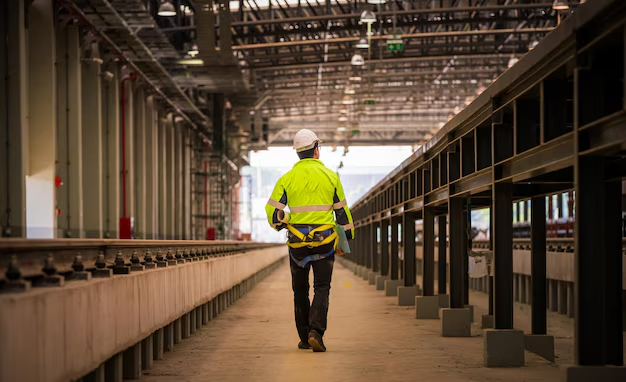
The factory floor looks different than it did 20 years ago. Robots weld car frames. Algorithms schedule production runs. Computer vision systems catch defects faster than the human eye. Automation in manufacturing isn't a future scenario — it's already reshaping who does what, which skills matter, and how facilities are organized.
Understanding this shift matters whether you're a worker in the sector, a job seeker considering a manufacturing career, a manager navigating workforce changes, or just someone trying to make sense of headlines about AI and jobs.
Automation isn't one thing — it's a spectrum of technologies applied across different parts of production.
Mechanical automation has existed for decades: assembly lines, conveyor systems, CNC machines that cut materials to precise specifications. These replaced repetitive physical tasks but still required significant human oversight and operation.
Robotic automation introduced programmable machines capable of performing complex physical tasks — welding, painting, packaging, material handling. Industrial robots can work continuously and handle dangerous environments, making them attractive for both efficiency and safety reasons.
AI-driven automation is the newer layer. Machine learning systems can now monitor equipment for early signs of failure (called predictive maintenance), optimize supply chains in real time, inspect products using computer vision, and adjust production parameters without human input. This is qualitatively different from older automation because these systems can adapt, not just repeat.
Collaborative robots, or "cobots," represent a middle ground — machines designed to work alongside humans rather than replace them entirely, handling physically demanding or precision tasks while workers manage oversight and judgment-intensive work.
Not all manufacturing roles face the same pressure. The impact of automation depends heavily on what a job actually involves.
| Job Type | Nature of Work | Automation Impact |
|---|---|---|
| Repetitive assembly | High-volume, low-variation physical tasks | High displacement risk |
| Quality inspection | Visual/measurement checks on standard products | Moderate-to-high (computer vision) |
| Machine operation | Running and monitoring standard equipment | Shifting — more oversight, less manual input |
| Maintenance & repair | Diagnosing and fixing complex equipment | Growing demand, harder to automate |
| Process engineering | Designing and improving production systems | Lower displacement, high collaboration with AI |
| Production planning | Scheduling, logistics, supply coordination | Changing — AI assists but humans still direct |
| Skilled trades (welding, etc.) | Technical physical work with variable conditions | Partial automation; complex work remains human |
The pattern that emerges: routine and predictable tasks are most vulnerable; judgment, adaptability, and technical troubleshooting are more durable.
This doesn't mean displaced workers simply move into engineering roles — the skills gap is real and significant. What it means is that the types of roles available in manufacturing are shifting, not disappearing uniformly.
The honest picture isn't purely optimistic or pessimistic — it's uneven.
Jobs that have declined or are declining:
Jobs that are growing or evolving:
The challenge is that the jobs being created often require different credentials and training than the jobs being lost. A worker who spent 15 years on an assembly line has real expertise — but that expertise doesn't automatically transfer to programming a cobot or reading sensor dashboards. The transition isn't effortless, and it isn't uniform across age groups, regions, or industries.
Across manufacturing, certain skill sets have gained value as automation has expanded:
Technical literacy — Understanding how automated systems work, even without being an engineer. Workers who can read a diagnostic screen, interpret a sensor alert, or communicate with maintenance teams are increasingly valuable.
Adaptability — As production lines get reconfigured more frequently to accommodate shorter product runs and faster changeovers, flexibility matters more than mastery of a single fixed task.
Problem-solving in variable conditions — Automation handles routine situations well. It struggles with exceptions. Workers who can respond when something unexpected happens are filling a gap machines can't.
Data awareness — Many modern manufacturing environments generate continuous data on output, quality, and equipment health. Comfort with reading and acting on that data is becoming a baseline expectation in some facilities.
Cross-functional communication — As facilities integrate more technology, collaboration between operations, IT, and engineering becomes essential. Workers who can bridge those conversations are in short supply.
None of this means every manufacturing worker needs a computer science degree. But the minimum baseline for many roles is shifting upward.
The impact of automation isn't uniform — individual circumstances matter enormously.
Tenure and role play a big part. A veteran machinist with deep knowledge of materials and tolerances may find their expertise more valuable in an automated facility, not less. An entry-level assembly worker doing highly repetitive work faces a different reality.
Geography shapes exposure significantly. Automation adoption varies by region, industry segment, and facility size. A large automotive plant in a major industrial hub may be far more automated than a mid-sized contract manufacturer in a smaller market.
Industry segment matters. Auto manufacturing, electronics, food processing, pharmaceuticals, and aerospace all use automation differently, at different rates, and with different workforce implications.
Employer investment in retraining varies widely. Some manufacturers have invested in internal training programs and partnerships with community colleges to reskill workers. Others have not. The same external trend can play out very differently depending on where a worker is employed.
Age and adaptability factor in, though not in a simple way. Younger workers entering the field often encounter automation as a given. Experienced workers may face steeper learning curves but often bring irreplaceable contextual knowledge about their products and processes.
Earlier waves of factory automation mechanized physical tasks. AI adds something different: the ability to analyze patterns, make predictions, and adjust behavior.
In practice, this shows up as:
What AI doesn't do well — yet — is handle the genuinely novel, the physically complex, or the socially nuanced. It can't troubleshoot a production problem it's never seen, negotiate with a supplier, or manage a safety incident. Those remain human responsibilities.
The more significant long-term question is how quickly AI capabilities expand and at what cost — factors that will determine how far automation penetrates into tasks that currently seem safely human.
If you work in manufacturing or are considering it, the relevant questions aren't "will robots take all the jobs" (too broad) or "am I safe" (impossible to answer generically). The more useful questions are:
The shift is real and ongoing. But within that broad trend, individual outcomes depend on specific roles, specific employers, specific markets, and the choices workers and companies make in response.