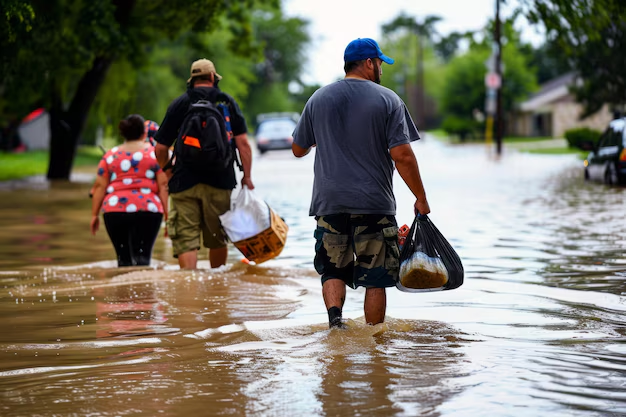
Natural disasters occupy a specific and urgent corner of the broader Environment & Climate conversation. Where climate discussions often focus on long-term trends, systemic change, and policy responses, natural disasters zoom in on discrete, high-impact events — the earthquake, the flood, the wildfire — and the forces that determine who is affected, how severely, and what recovery looks like. Understanding this distinction matters because the questions are different, the timescales are different, and the factors that shape outcomes at the individual and community level are different too.
This page maps the landscape of natural disasters: what they are, how science understands them, how climate intersects with them, and what variables shape exposure and resilience. It's the starting point for deeper exploration across every aspect of the topic.
A natural disaster is typically defined as a natural hazard event that causes significant harm to people, property, or infrastructure. The "disaster" part is key — it's not the event itself, but the intersection of that event with human systems. A magnitude 7.0 earthquake in an uninhabited region is a geological event. The same earthquake beneath a densely populated city is a disaster.
Scientists and emergency managers often use the term natural hazard to describe the physical phenomenon itself (a hurricane, a volcanic eruption, a drought), reserving "disaster" for when those hazards meet vulnerable populations. This framing is important because it shifts attention toward what can be modified: exposure, preparedness, infrastructure, and early warning systems.
Natural disasters are generally grouped into several broad categories:
The line between categories blurs frequently. A hurricane is meteorological, but it brings hydrological flooding. A drought is climatological, but it creates conditions for wildfires. Understanding these overlaps helps explain why disaster response is rarely straightforward.
Natural disasters predate human influence on the climate system — earthquakes and volcanic eruptions have no meaningful link to rising greenhouse gas concentrations. But for weather- and climate-related hazards, the relationship between climate change and disaster risk is a major and active area of scientific research.
The field of attribution science has developed significantly over the past two decades, allowing researchers to estimate the degree to which human-caused climate change altered the probability or intensity of specific extreme weather events. Studies in this field vary in confidence depending on the type of event. Research has found, with relatively high confidence, that climate change has increased the frequency and intensity of certain events — extreme heat episodes being among the clearest examples. For tropical cyclones, floods, and wildfires, the evidence is meaningful but more context-dependent: climate change is generally found to influence conditions that drive these events, even when the relationship isn't perfectly linear.
It's worth noting that attribution studies carry their own methodological limitations, and findings continue to be refined as data improves. What the research broadly shows, however, is that the background conditions for many climate-related hazards are shifting — which affects risk assessments, planning timelines, and infrastructure design.
Not all natural hazard events produce the same outcomes, even when they appear similar in scale. Several interconnected factors shape severity.
Exposure refers to how many people, assets, and systems are located where a hazard can reach them. Coastal development, floodplain settlement, and urban expansion into wildfire-prone areas all increase exposure over time.
Vulnerability describes how susceptible those people and systems are to harm. Older buildings constructed before modern seismic codes, communities with limited access to healthcare, and populations without reliable warning systems are more vulnerable — not because the hazard is different, but because the capacity to absorb and respond to it is lower.
Coping capacity encompasses the resources available to respond during and after an event: emergency services, social networks, financial reserves, insurance coverage, and government support systems. Communities with stronger coping capacity tend to experience less severe overall outcomes from equivalent hazard events, though this is a general pattern, not a guarantee for any individual situation.
This three-part framework — exposure, vulnerability, and coping capacity — is central to how researchers and disaster risk professionals think about why disasters unfold differently across regions and populations.
One of the most well-documented findings in disaster research is that preparedness and early warning systems substantially reduce harm from natural hazards, particularly for meteorological and hydrological events. The lead time provided by modern hurricane forecasting, for example, has enabled large-scale evacuations that research suggests have saved significant numbers of lives compared to historical outcomes from similarly powerful storms.
Early warning systems — the combination of monitoring technology, communication infrastructure, and public response protocols — vary significantly in coverage and reliability around the world. In some regions, robust systems provide days of advance notice for floods or cyclones. In others, gaps in technology, infrastructure, or public communication mean warnings arrive too late or not at all. This disparity is itself an area of active research and international development work.
Preparedness at the household and community level — emergency plans, supply stockpiles, knowledge of local hazards and evacuation routes — interacts with formal warning systems. Research generally shows that preparedness behaviors improve outcomes, but uptake varies widely based on factors including risk perception, past experience with disasters, access to information, and socioeconomic circumstances.
Post-disaster recovery is one of the most complex and least linear phases of the disaster cycle. The period immediately following an event involves emergency response — search and rescue, medical care, and temporary shelter. Longer-term recovery involves rebuilding homes and infrastructure, restoring livelihoods, and addressing psychological impacts.
Research on recovery outcomes consistently identifies several factors that shape how quickly and fully individuals and communities recover:
Financial resources and insurance play a substantial role. Access to disaster insurance, savings, or external financial assistance affects both the speed and quality of physical rebuilding. Gaps in insurance coverage — which vary considerably by disaster type, region, and individual policy — can leave affected households bearing significant costs independently.
Social cohesion and networks — the strength of community ties and mutual support — appear in the research literature as meaningful contributors to recovery, particularly in the period immediately following a disaster when formal systems may be overwhelmed or delayed.
Mental health impacts are documented across disaster types. Displacement, loss, and exposure to traumatic events are associated with elevated rates of anxiety, depression, and post-traumatic stress. Research also notes that mental health impacts can persist well beyond the immediate emergency phase, and that access to support varies considerably.
Underlying inequalities tend to shape recovery in ways that parallel their role before disasters. Populations with fewer financial resources, less stable housing, or more limited access to services typically face steeper recovery paths. This is a consistent finding across the disaster research literature, though the specific dynamics vary significantly by context.
Several specific questions naturally emerge within the natural disasters topic, each deep enough to warrant its own focused exploration.
Disaster preparedness by hazard type is an area where individual circumstances matter enormously. The preparations relevant to someone living in a seismically active region differ significantly from those facing hurricane risk or wildfire exposure. Understanding the specific hazards relevant to a given location — and the recommended preparedness steps for those hazards — is where general knowledge translates into practical context.
The science of specific disaster types is another major thread. How do tornadoes form? What drives wildfire spread? How are tsunamis generated, and why are some coastlines more exposed than others? Each hazard type has its own physical mechanics, forecasting challenges, and history of scientific understanding, and that knowledge shapes how they're monitored and how warnings are communicated.
Climate change and changing disaster risk is perhaps the fastest-moving area within this sub-category. How attribution science works, what the research currently shows about specific hazard types, and how risk projections are built and interpreted are all questions with evolving answers — and all carry important caveats about the strength and limitations of current evidence.
Disaster policy and global frameworks covers how governments and international institutions approach disaster risk reduction. The Sendai Framework for Disaster Risk Reduction, adopted in 2015, represents the current international policy consensus on how to reduce disaster losses globally. Understanding what these frameworks aim for, how progress is measured, and where gaps persist is relevant context for anyone trying to understand why disaster outcomes differ so much across countries and regions.
Community and individual resilience pulls together the research on what enables people and communities to absorb, adapt to, and recover from disasters — including the social, economic, and psychological factors that shape resilience and the evidence on what preparedness and mitigation measures the research supports.
What applies in each of these areas depends heavily on where a person lives, what hazards are locally relevant, what resources and infrastructure surround them, and what their specific circumstances look like. The research provides a map of the landscape — but reading that map usefully requires knowing your own location within it.