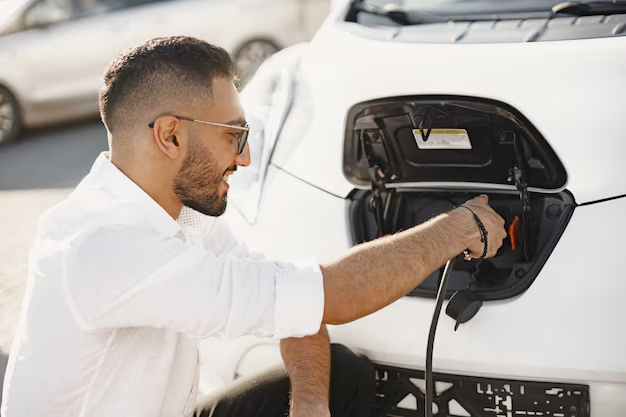
The EV market has matured significantly over the past few years, but it still comes with enough nuance that buying, charging, and owning one looks very different depending on where you live, how you drive, and what you expect. Here's a clear-eyed look at where things stand — what's changed, what still matters, and what questions are worth asking before you decide anything.
An electric vehicle (EV) replaces a combustion engine with one or more electric motors powered by a large battery pack. You charge the battery by plugging into an outlet or a dedicated charging station, and the car converts stored energy into motion with no tailpipe emissions.
The main types you'll encounter:
| Type | What It Means |
|---|---|
| BEV (Battery Electric Vehicle) | Fully electric. No gas engine. Runs entirely on battery power. |
| PHEV (Plug-in Hybrid Electric Vehicle) | Has both a battery and a gas engine. Can run on electricity for shorter trips, gas for longer ones. |
| HEV (Hybrid Electric Vehicle) | Has a small battery that charges itself through braking. Cannot be plugged in. |
| FCEV (Fuel Cell Electric Vehicle) | Uses hydrogen to generate electricity onboard. Very limited availability currently. |
Most of the mainstream conversation in 2025 centers on BEVs and PHEVs, which is where the widest range of models and price points now exists.
Range anxiety — the fear of running out of charge mid-trip — was one of the biggest objections to EVs for years. The picture has improved meaningfully.
Many current BEVs now offer ranges that cover the vast majority of everyday driving for most people. Entry-level models often deliver somewhere in the 150–250 mile range per charge, while longer-range trims and premium models can push well beyond that. PHEVs typically offer a much shorter all-electric range — often enough for daily commuting — before the gas engine takes over.
What affects real-world range:
The advertised range on a window sticker reflects standardized testing conditions. Real-world range almost always varies from that number, sometimes meaningfully.
Charging infrastructure and setup is where the experience of EV ownership diverges most dramatically between drivers. There are three main charging levels:
Level 1 uses a standard household outlet. It's the slowest option — adding roughly a few miles of range per hour. Fine for topping off a PHEV overnight; less practical as a primary charging method for a BEV.
Level 2 requires a 240V outlet, similar to what a dryer uses. Many EV owners install a dedicated home charger. This adds significantly more range per hour and is the most common everyday charging setup for home use.
DC Fast Charging (Level 3) is found at public charging stations and can add substantial range in 20–45 minutes depending on the vehicle and charger capacity. Not all EVs charge at the same speed, and not all chargers are equally capable.
Whether home charging is practical depends on your housing situation. Owners with a garage or dedicated parking spot can often install Level 2 charging relatively easily. Apartment dwellers and those without off-street parking face a real challenge — they're dependent on public charging networks, which vary widely in reliability, density, and cost by region.
The public charging landscape has expanded considerably, but it remains uneven. Major charging networks have grown their footprints in urban areas and along highways, but rural coverage can still be thin. Reliability has also historically been inconsistent — a meaningful percentage of public chargers are out of service at any given time, though the industry has been investing in improvements.
Connector standards are worth noting: most non-Tesla EVs in North America have been converging on the NACS (North American Charging Standard) connector, previously used exclusively by Tesla. This simplification benefits consumers, but it's worth confirming compatibility for any vehicle you're considering.
EVs typically have a higher upfront purchase price than comparable gas vehicles at the same trim level, though the gap has narrowed as production scales up. The financial picture becomes more complex when you factor in:
Whether an EV saves you money over a given ownership period depends heavily on your specific driving patterns, electricity rates, charging access, and how long you keep the vehicle.
A few developments are worth knowing about heading into this year:
Understanding the landscape is one thing. Figuring out whether an EV fits your life requires honest answers to a few practical questions:
None of these questions have universal answers. They're the variables that determine whether EV ownership is genuinely practical and cost-effective for a specific person — or whether a PHEV or a conventional vehicle is the more sensible fit right now.
The technology is real, the market is serious, and for many drivers the case is compelling. But "many drivers" is not a synonym for "every driver," and the honest answer always starts with your own situation.