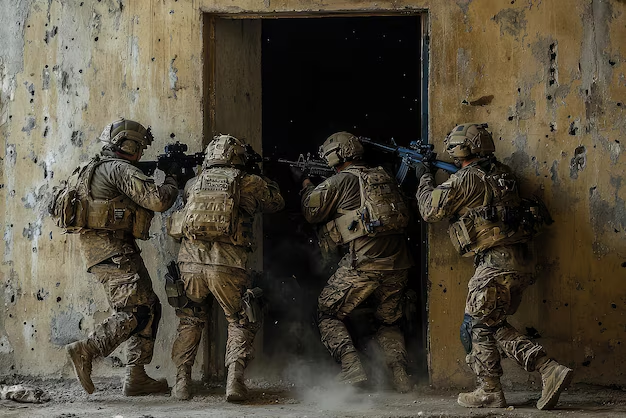
When two powerful countries want to fight each other but don't want to go to war directly, they often find a third party to fight for them. That's the core idea behind a proxy war — and it's one of the most common, and most consequential, forms of conflict in modern history.
Understanding how proxy wars work helps make sense of some of the most persistent and destructive conflicts in the world today.
A proxy war is an armed conflict in which one or more outside powers support opposing sides — financially, militarily, or politically — without directly engaging each other on the battlefield.
The word "proxy" means acting on behalf of someone else. In this context, a local or regional armed group fights a war that also serves the strategic interests of a more powerful patron state operating in the background.
The fighting happens in one country. The stakes often extend far beyond it.
🌍 Proxy conflicts are not a modern invention — they shaped rivalries throughout the Cold War, colonial history, and ancient great-power competition — but the term has become especially prominent in 20th and 21st century geopolitics.
The short answer: plausible deniability and reduced risk.
Direct war between major powers — especially nuclear ones — carries catastrophic consequences. Proxy warfare lets powerful states pursue strategic goals while keeping the formal conflict at arm's length. Key motivations include:
The patron state gains strategic leverage. The proxy force gains weapons, money, training, or political legitimacy it couldn't otherwise obtain.
A proxy conflict typically involves three types of actors:
| Role | Who They Are | What They Do |
|---|---|---|
| Patron State | A powerful external country or alliance | Provides funding, weapons, intelligence, and political cover |
| Proxy Force | A local military group, faction, or government | Does the actual fighting on the ground |
| Target State / Rival Patron | The opposing power and its allied forces | The ultimate adversary the patron hopes to counter or weaken |
In practice, the lines blur. A proxy force may have its own goals that don't perfectly align with its patron. A target state may also have patron support. Many proxy wars involve multiple patrons backing multiple factions, creating layered and chaotic conflict environments.
Patron states support proxies in several ways, and the mix varies widely by conflict:
The level of direct involvement sits on a spectrum. At one end, a patron might simply sell weapons to a government. At the other, it might have special forces operating alongside proxy troops, making the line between "proxy" and "direct" war increasingly thin.
🔍 Several features distinguish proxy wars from conventional interstate conflict or purely civil war:
1. Diffuse accountability Because patron states aren't formally at war, international legal and political accountability becomes complicated. Sanctions, war crimes investigations, and diplomatic pressure all face higher bars when sponsorship is indirect or deniable.
2. Extended duration Proxy wars often last far longer than they would without outside support. When patrons keep resupplying both sides, local actors can continue fighting even when military or political resolution might otherwise occur. The Korean War, the conflicts in Vietnam, Angola, Afghanistan (in multiple eras), Syria, and Yemen all reflect how sustained external support prolongs violence.
3. Misaligned interests Patron and proxy often want different things. A patron may want to bleed a rival or control a trade route. The proxy may want to win a civil war, expel an ethnic group, or gain regional dominance. When the patron's strategic goals are met — or shift — support can evaporate, leaving the proxy in a vulnerable position.
4. Civilian consequences The populations living inside the conflict bear the direct costs — casualties, displacement, infrastructure destruction, economic collapse — while the patron states absorb comparatively little. This asymmetry is one of the most ethically significant features of proxy warfare.
Proxy wars can conclude in several ways, and the outcome depends heavily on the interplay between patrons, proxies, and ground conditions:
What determines which path a conflict takes involves a mix of geopolitical shifts, domestic politics within patron states, battlefield dynamics, economic pressures, and the agency of the proxy forces themselves.
"The proxy is just a puppet." Not always. Proxy forces often have independent goals, constituencies, and decision-making structures. They may accept support while pursuing their own agenda — sometimes to the patron's frustration.
"Proxy wars are less destructive than 'real' wars." For the people living through them, this distinction is meaningless. Proxy conflicts have produced some of the highest civilian death tolls and displacement crises of the past century.
"If a country isn't officially at war, it isn't responsible." International law — including rules around arms transfers and the financing of atrocities — does address external actors in proxy conflicts, though enforcement is inconsistent and politically contested.
If you're trying to understand a specific conflict in the news, the following questions help cut through the noise:
⚖️ Proxy wars sit at the intersection of international relations, military strategy, and human rights — and nearly every major geopolitical rivalry of the past century has expressed itself, at least in part, through one.