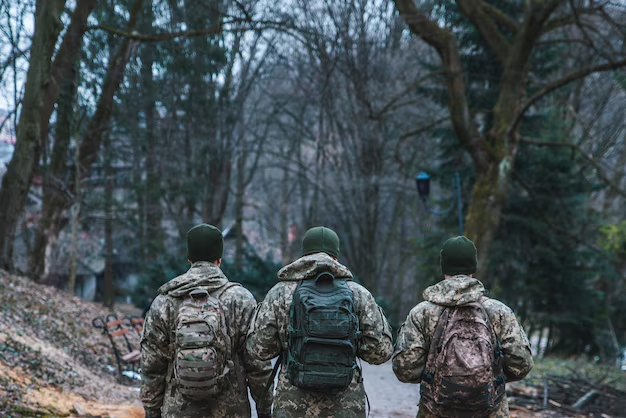
When a war ends — or sometimes before it fully does — someone has to help hold the peace together. That's where peacekeeping comes in. It's one of the most visible and debated tools the international community uses to manage conflict, yet most people only encounter the term in headlines without fully understanding what peacekeepers actually do, who sends them, or why missions sometimes succeed and sometimes don't.
Here's a clear breakdown of how peacekeeping works in practice.
Peacekeeping refers to the deployment of personnel — typically soldiers, police officers, and civilian specialists — into a conflict zone or post-conflict area to help maintain stability and support a peace process. The goal is not to win a war but to create the conditions under which lasting peace becomes possible.
Unlike a military invasion or a combat operation, traditional peacekeeping is built on three foundational principles:
These principles are what distinguish peacekeeping from war-fighting, though in practice the line can become complicated.
The United Nations is the largest organizer of international peacekeeping operations. A UN peacekeeping mission is authorized by the UN Security Council, which passes a resolution defining the mission's mandate, scope, and duration.
The troops, police, and civilian personnel are not a standing UN army — they're contributed voluntarily by member states. Countries that send personnel are called troop-contributing countries (TCCs). The UN reimburses those countries at a standard rate, which makes peacekeeping participation financially meaningful, particularly for smaller or developing nations.
The UN Department of Peace Operations (DPO) oversees mission management from New York, while a Special Representative of the Secretary-General typically leads each mission on the ground.
Beyond the UN, other organizations also run peacekeeping-style operations:
Each structure comes with different rules, funding mechanisms, and chains of command.
The day-to-day work of a peacekeeping mission varies enormously depending on the mandate and the situation, but common tasks include:
| Function | What It Involves |
|---|---|
| Monitoring ceasefires | Observing and reporting violations of agreed truces |
| Protecting civilians | Physically guarding vulnerable populations, especially in camps or conflict-prone areas |
| Supporting elections | Providing security and logistical support for democratic transitions |
| Disarmament programs | Helping collect and destroy weapons from former combatants |
| Police reform | Training and advising local law enforcement |
| Rule of law support | Assisting with courts, corrections, and legal institutions |
| Humanitarian facilitation | Creating safe corridors for aid delivery |
Modern missions are often described as multidimensional — meaning they combine military, police, and civilian components working together rather than just deploying soldiers to watch a ceasefire line.
The process from recognizing a crisis to boots on the ground typically follows a recognizable path:
One of the most discussed limitations of this system is the Security Council veto. If a permanent member opposes authorization — for political reasons or because their own interests are involved — a mission may never launch even when need is clear.
Peacekeeping has a mixed track record, and understanding why requires looking at the variables that shape whether a mission can succeed.
Factors that tend to support success:
Factors that create difficulty:
The phrase "there is no peace to keep" is frequently used by analysts to describe situations where peacekeepers are deployed into active wars rather than post-conflict stabilization. This fundamentally changes what the mission can realistically accomplish.
Traditional peacekeeping assumed a ceasefire already existed. But over time — especially after the failures in Rwanda and Srebrenica in the 1990s, where peacekeepers were present but unable to prevent mass atrocities — the international community shifted toward authorizing more muscular mandates.
Robust peacekeeping allows forces to use military force not just in self-defense but to protect civilians and defend the mission's mandate, even without an immediate threat to the peacekeepers themselves. This is not the same as peace enforcement (which involves fighting to impose a settlement), but it does give commanders more operational flexibility.
The Force Intervention Brigade deployed in the Democratic Republic of Congo is a notable example — it was explicitly authorized to take offensive action against armed groups, a significant departure from traditional peacekeeping norms.
This evolution reflects ongoing tension between the principle of sovereignty (host countries control what happens within their borders) and the international responsibility to protect civilians from atrocities.
No two peacekeeping situations are alike, and what works in one context may be entirely inappropriate in another. The variables that matter most include:
Understanding these factors helps explain why observers, policymakers, and scholars disagree so sharply about specific missions — and why evaluating any single operation requires examining its particular context rather than applying a universal standard.
Peacekeeping is not a single, fixed thing — it's a constantly evolving set of tools, institutions, and approaches that the international community continues to debate, reform, and deploy in response to some of the world's most difficult situations. Whether a given mission is the right tool for a given crisis depends on facts that vary with every conflict.