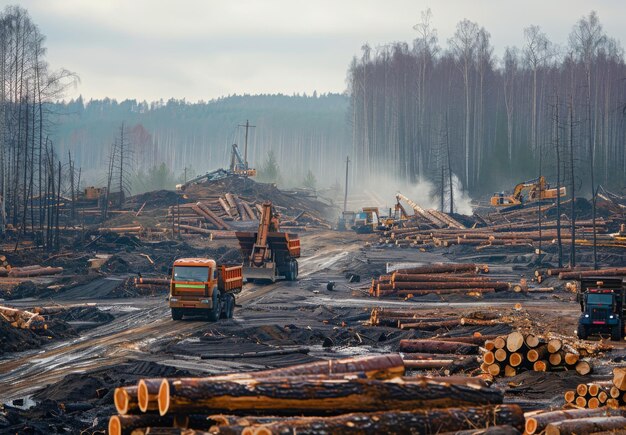
Forests cover roughly a third of Earth's land surface, and they do far more than provide timber or scenic landscapes. They regulate climate, filter water, shelter biodiversity, and store vast amounts of carbon. When they disappear — whether through logging, agriculture, fire, or development — the consequences ripple outward in ways that affect people and ecosystems far from where the trees once stood.
Understanding deforestation rates, what drives them, and what's at stake helps make sense of one of the most consequential environmental issues of our time.
Deforestation refers to the permanent or long-term removal of forest cover, converting that land to another use — farmland, pasture, roads, or urban development. It's distinct from forest degradation, where trees are thinned or damaged but the land technically remains forested, and from deforestation followed by regrowth, where forests recover over time.
When scientists and policymakers talk about deforestation rates, they're typically measuring:
These distinctions matter enormously. A country might show modest net forest loss while experiencing dramatic gross loss if plantation forests are growing elsewhere. A plantation of fast-growing timber trees is not ecologically equivalent to old-growth rainforest, even if the numbers look similar on paper.
Deforestation is not evenly distributed. A few geographic patterns consistently stand out across monitoring data from organizations like the Food and Agriculture Organization (FAO) and satellite-based systems like Global Forest Watch:
🌍 Tropical forests bear the heaviest losses. Regions in South America, Central Africa, and Southeast Asia account for a disproportionate share of global tree cover loss. Tropical forests are particularly valuable ecologically — they hold extraordinary biodiversity and store large amounts of carbon — which makes their loss especially significant.
Temperate and boreal forests in North America, Europe, and Russia also experience loss, though patterns vary widely by country, policy environment, and economic pressures.
Key regions where deforestation has been especially pronounced in recent decades include:
| Region | Primary Drivers |
|---|---|
| Amazon Basin | Cattle ranching, soy farming, infrastructure |
| Congo Basin | Subsistence agriculture, charcoal production |
| Southeast Asia | Palm oil, pulpwood plantations, smallholder farming |
| Central America | Cattle, agriculture, development |
| West Africa | Cocoa farming, logging, charcoal |
This table reflects broad patterns, not a complete picture — drivers vary significantly even within individual countries.
No single cause explains deforestation globally. It's driven by a combination of direct causes (proximate drivers) and underlying pressures (root causes) that vary by region.
🌱 Forests aren't just trees. They're complex systems that perform functions the global environment — and human civilization — depends on.
Forests absorb carbon dioxide from the atmosphere as they grow, storing it in wood, roots, and soil. When forests are cut and burned, that stored carbon is released back into the atmosphere. Deforestation is estimated by researchers to be a significant contributor to annual greenhouse gas emissions globally, though the precise share is debated and varies by year and methodology. Protecting standing forests and restoring degraded ones are both recognized as important components of climate strategies.
Tropical forests in particular contain an enormous proportion of Earth's terrestrial species — many not yet fully documented by science. Habitat destruction is one of the leading causes of species extinction. Fragmented forests reduce viable habitat, disrupt migration and breeding patterns, and increase the risk of local extinction even for species that haven't been directly displaced.
Forests play a critical role in the water cycle. They absorb rainfall, reduce runoff, recharge groundwater, and release water vapor into the atmosphere through a process called transpiration. Large-scale deforestation can reduce regional rainfall, alter river flows, and increase the severity of both floods and droughts. Communities that depend on forest watersheds for drinking water and agriculture are particularly vulnerable.
Tree roots hold soil in place. Remove the trees, and erosion accelerates — particularly on slopes and in areas with heavy rainfall. Degraded soils can become less productive for agriculture over time, contributing to a cycle where farmers clear more forest to compensate for declining yields elsewhere.
Hundreds of millions of people live in or near forests and depend on them directly for food, medicine, water, and livelihoods. Deforestation displaces communities, disrupts traditional ways of life, and can spark conflict over land rights. Research also suggests that forests managed by Indigenous communities often show lower rates of deforestation, making land rights and governance central to any effective forest protection strategy.
The picture is mixed. Some countries have dramatically reduced deforestation rates through policy changes, law enforcement, economic shifts, and international support. Others have seen rates accelerate in recent years following changes in governance, land policy, or economic incentives.
Reforestation and afforestation — planting trees on previously forested or non-forested land — are growing globally. But as noted earlier, new plantations rarely replicate the ecological complexity of the forests they replace. Scientists distinguish between primary forest (never substantially disturbed by humans) and secondary forest (regrown after clearing), with primary forest generally considered far more ecologically valuable.
Several factors determine whether a country's forests expand or contract:
Modern deforestation tracking relies heavily on satellite remote sensing, which allows near-real-time monitoring of tree cover change at global scale. Platforms like NASA's MODIS satellite system and commercial imagery processed through tools like Global Forest Watch have dramatically improved the ability to detect and quantify forest loss.
No measurement system is perfect — cloud cover, sensor resolution, and definitions of "forest" all affect results — but satellite-based monitoring has made it far harder for deforestation to go undetected in areas with coverage.
The FAO also conducts periodic Global Forest Resource Assessments based on country-reported data, which provide a complementary but methodologically different view of global trends.
The pace at which forests disappear or recover over the coming decades will shape outcomes in climate, biodiversity, freshwater availability, and human welfare in ways that extend well beyond any single country or region.
What determines where things head includes policy decisions at every level — from international climate agreements and trade rules to national land-use laws and local land tenure systems — as well as the consumption choices embedded in global supply chains. Understanding the mechanics of deforestation is the starting point for making sense of why so many of those debates are as contested and consequential as they are.