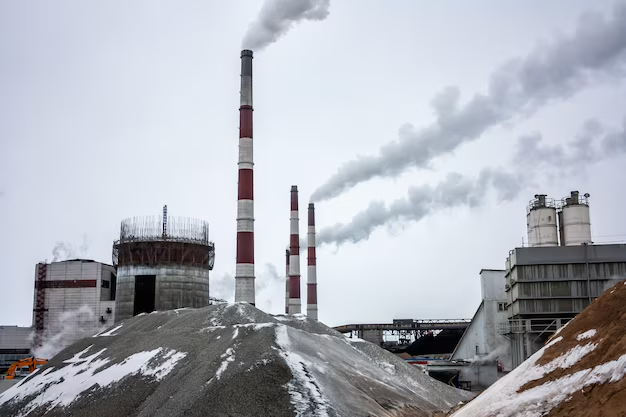
Carbon capture is one of the most discussed — and most debated — tools in the climate conversation. Supporters call it an essential bridge to a cleaner future. Critics call it a distraction from cutting emissions at the source. The truth, like most things in science, is more layered than either camp admits. Here's what carbon capture actually is, how the different approaches work, and what the honest evidence says about its promise and its limits.
Carbon capture is a broad term for technologies and processes that remove carbon dioxide (CO₂) from the atmosphere or intercept it before it gets there. The goal is to reduce the concentration of greenhouse gases that drive climate change.
There are two fundamentally different things people mean when they say "carbon capture," and conflating them causes a lot of confusion:
These are different problems with different technologies, different costs, and different scales of impact.
Point-source systems are installed at industrial facilities where CO₂ is produced in high concentrations. Because the gas is dense and localized, it's far cheaper to capture here than from open air.
The basic process works in three stages:
Underground storage typically targets depleted oil and gas reservoirs or deep saline aquifers, where the CO₂ is trapped by rock formations. The goal is permanent containment — keeping that carbon out of the atmosphere indefinitely.
CCU takes a different path: using captured CO₂ as a feedstock for products like synthetic fuels, concrete, or chemicals. The climate benefit here depends heavily on whether the CO₂ stays locked in that product long-term or gets re-released quickly.
Direct air capture (DAC) is the technology that removes CO₂ directly from ambient air. It's conceptually appealing — clean up CO₂ wherever it came from, not just at the smokestack. But the atmosphere contains CO₂ in very low concentrations, which makes the physics and economics dramatically harder.
DAC facilities use large fans to pull air through chemical systems that bind CO₂. That CO₂ is then released under heat, captured in concentrated form, and either stored underground or used.
The core challenge: because atmospheric CO₂ is so dilute, DAC requires significant energy to process enormous volumes of air. The energy source matters enormously — DAC powered by fossil fuels can, in some configurations, emit as much or more CO₂ than it captures. DAC powered by low-carbon energy is a genuine net removal tool, but also significantly more expensive.
Current DAC facilities operate at relatively small scales compared to global emissions. Scaling this technology to climate-relevant levels is a major engineering and economic challenge that remains unsolved.
Not all carbon removal involves industrial machinery. Nature-based solutions are among the oldest and most widely understood forms of carbon capture:
| Approach | How It Captures Carbon | Key Limitations |
|---|---|---|
| Reforestation | Trees absorb CO₂ as they grow | Vulnerable to fire, drought, and land use change |
| Soil carbon sequestration | Improved farming practices store carbon in soil | Storage can be reversed; difficult to measure accurately |
| Wetland and peatland restoration | These ecosystems store large amounts of carbon | Slow process; threatened by development |
| Ocean-based approaches | Algae, seaweed, and chemical processes | Still largely experimental; ecosystem risks not fully understood |
| Bioenergy with CCS (BECCS) | Grow plants (which absorb CO₂), burn for energy, capture emissions | Competes for land and water; logistics are complex |
Nature-based approaches are generally lower-cost than industrial methods but come with real uncertainties around permanence and scale.
This is where the evidence gets genuinely complicated.
What the evidence supports:
What the evidence questions:
Not all carbon capture is equal. Outcomes depend heavily on:
The emission source — High-concentration industrial sources (steel, cement, natural gas processing) are more viable for CCS than low-concentration or dispersed sources.
The energy source — Carbon capture powered by clean energy delivers genuine net removal. Powered by fossil fuels, the math gets complicated quickly.
Storage permanence — Geological storage has a strong track record at monitored sites. Nature-based storage is more variable and can be reversed.
Scale and efficiency — Small, well-run pilot projects often outperform large commercial rollouts. Scale introduces new engineering and operational variables.
What it's compared to — Carbon capture at a coal plant reduces emissions from that plant, but the same investment in renewable energy might displace more total emissions. These tradeoffs are real and context-dependent.
The scientific and policy consensus is roughly this: carbon capture is likely a necessary part of the climate toolkit, but not a substitute for reducing emissions at the source. Some industrial processes — like cement production, where CO₂ is a chemical byproduct of the process itself, not just the energy used — are extremely difficult to decarbonize without CCS. In those cases, capture technology may be one of the only viable paths.
For other sectors, the calculus is less clear. The question isn't whether carbon capture works in principle — it does — but whether it works well enough, cheaply enough, and at sufficient scale to matter within the timelines that climate targets require. That's an active area of research, investment, and honest debate. ♻️
Understanding where carbon capture fits requires knowing which technologies you're evaluating, in which applications, powered by what energy, and compared to what alternatives. The landscape is real and it's developing — but no single project or technology tells the whole story.