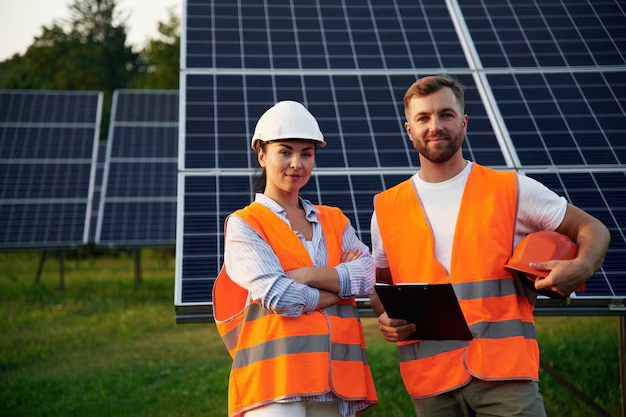
Renewable energy has moved from the margins of the global power supply to one of its fastest-growing sectors. What was once considered an idealistic alternative is now a mainstream economic and infrastructure reality — driven by falling costs, government policy, technological advancement, and growing pressure to reduce carbon emissions. Understanding how that growth is happening, and what's shaping it, helps make sense of energy headlines and the broader shifts unfolding in how the world powers itself.
Renewable energy comes from sources that naturally replenish on a human timescale — sunlight, wind, moving water, geothermal heat, and organic matter (biomass). Unlike coal, oil, or natural gas, these sources don't get used up in the way fossil fuels do.
The major categories are:
Each source has its own profile of strengths, limitations, and best-suited geographies. That mix matters when understanding why different regions are growing in different ways.
A generation ago, renewable energy was significantly more expensive than fossil fuel power in most markets. That equation has changed dramatically — and the shift is the single biggest driver of global growth.
Cost reduction has been the defining story, particularly in solar and wind. The price of solar panels dropped by a remarkable degree over the past decade or more, making utility-scale solar competitive with — or cheaper than — conventional generation in many regions. Onshore wind has followed a similar path.
Other forces accelerating growth include:
These forces don't apply equally everywhere. The pace of growth in any country or region depends on its policy environment, geography, existing infrastructure, and financial capacity.
There is no single story of renewable energy expansion — the landscape varies significantly by region.
| Region | Notable Strengths | Key Growth Drivers |
|---|---|---|
| Europe | Offshore wind, solar in southern regions | Aggressive policy targets, carbon pricing |
| China | Solar manufacturing, wind capacity | Scale of investment, industrial policy |
| United States | Wind (central plains), solar (southwest) | Federal incentives, state-level mandates |
| India | Solar potential, growing capacity | Cost reduction, energy access goals |
| Africa | Abundant solar, geothermal (East Africa) | Off-grid electrification, development finance |
| Latin America | Hydropower base, growing solar and wind | Resource richness, investment interest |
| Southeast Asia | Mixed development pace | Varying policy environments, growing demand |
China has become the world's largest producer of solar panels and a dominant force in wind energy, both in installed capacity and manufacturing scale. Its sheer size means its choices ripple through global supply chains and pricing.
Europe has pushed aggressively into offshore wind — particularly the North Sea — and set some of the world's most ambitious renewable targets in response to climate commitments and energy security pressures.
Developing regions face a different set of dynamics. In parts of sub-Saharan Africa and South and Southeast Asia, the priority isn't replacing old fossil fuel infrastructure — it's expanding access to electricity for populations that have had little or none. In those contexts, distributed solar (small-scale systems for homes and communities) is growing as a practical path to electrification that doesn't require large grid infrastructure.
While all renewable sources are growing to varying degrees, solar and wind together account for the largest share of new capacity additions globally in recent years — and that trend appears likely to continue.
Solar PV can be deployed at scales ranging from a single rooftop to a hundreds-of-acres utility installation. Its modularity and rapidly declining cost have made it broadly accessible across income levels and geographies.
Wind power excels in areas with strong, consistent wind — coastal regions, open plains, and increasingly offshore locations where winds are stronger and more reliable. Offshore wind technology has matured significantly, unlocking capacity in densely populated coastal countries where land is limited.
Hydropower remains the largest single source of renewable electricity globally by total output — much of it long-established infrastructure. New large hydro projects are more contested now due to environmental and social impacts, but small-scale and run-of-river hydro continues to develop in some regions.
Geothermal is highly localized — it's most viable in geologically active areas like Iceland, Kenya, New Zealand, and parts of the western United States. Where it's available, it offers a highly reliable, baseload power source.
Biomass and bioenergy play a role in some markets, though they carry more complex environmental trade-offs and are generally not growing as quickly as solar or wind.
Rapid growth doesn't mean uncomplicated growth. Several real challenges influence how quickly renewable energy can expand and integrate into existing energy systems.
Grid integration is one of the most discussed. Solar and wind are variable sources — they generate power when the sun shines or the wind blows, not necessarily when demand peaks. Managing that variability requires investment in energy storage (like large-scale batteries), grid modernization, and smarter demand management. This is an active area of engineering and policy work in most major energy markets.
Infrastructure and transmission pose challenges in many countries — particularly where population centers are far from the best renewable resources, or where existing grid infrastructure is aging or underdeveloped.
Supply chain and materials have emerged as considerations. The manufacturing of solar panels, wind turbines, and batteries requires specific minerals and materials — some of which are concentrated in particular countries — raising questions about supply security and environmental impact of extraction.
Policy consistency matters enormously to investors. Renewable energy projects involve large upfront capital costs and long operating lifespans. Uncertainty about future subsidies, regulations, or energy pricing can slow investment even where resources are plentiful.
The phrase energy transition describes the broader shift from fossil fuel-dominated energy systems toward lower-carbon alternatives. Renewable electricity is a central part of that transition, but not the only one.
Electrification — converting end uses like heating, transportation, and industrial processes from burning fuels directly to using electricity — depends on that electricity becoming cleaner. That's why growth in renewable power generation is tightly linked to questions about electric vehicles, heat pumps, and industrial decarbonization.
The transition looks different depending on a country's starting point. Nations with large existing fossil fuel industries face different political and economic pressures than those building energy systems more from scratch. Progress is uneven, contested, and shaped by local economics and politics as much as by technology.
A few areas are particularly worth following as the global picture develops:
The growth of renewable energy is one of the more consequential shifts in the global economy — with implications for climate, energy security, jobs, and geopolitics. The scale and pace of that shift vary widely by region, technology, and policy environment, which is why understanding the landscape means holding multiple stories at once rather than a single global narrative.