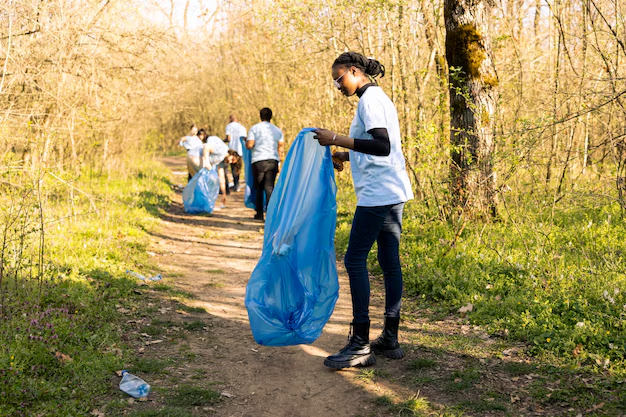
Plastic pollution has gone from a niche environmental concern to a headline crisis — but the full picture is more complicated than a viral photo of a turtle tangled in a six-pack ring. To understand how serious it actually is, you need to look at where plastic goes, what it does when it gets there, and why it's so hard to fix.
The core problem with plastic isn't that we use it — it's that most plastics are designed to be durable, which means they resist the biological breakdown that handles most other waste. A glass bottle shatters. A paper bag rots. Most plastics simply fragment into smaller and smaller pieces over time without fully decomposing.
This process produces what scientists call microplastics — particles smaller than 5 millimeters — and eventually nanoplastics, which are invisible to the naked eye. These aren't a future risk. They're already in oceans, soil, drinking water, and even the air. Research has detected them in human blood, lung tissue, and placentas, though what that means for long-term health is still an active area of scientific study.
The durability that makes plastic useful in a water pipe or a medical device becomes a liability when that same material ends up in a landfill, a river, or the ocean.
Here's what the science broadly agrees on, without reaching for unverifiable precision:
The sheer volume matters because plastic pollution isn't like a chemical spill you can clean up and declare resolved. It's a continuous, compounding flow — more added every year to what's already out there.
The harm isn't uniform. It plays out differently depending on the type of plastic, the environment it enters, and the species or system exposed.
Macroplastic — visible debris like bags, bottles, and fishing gear — poses well-documented threats to wildlife. Animals ingest it, become entangled in it, or mistake it for food. Ghost fishing gear (abandoned nets and lines) continues trapping marine life long after it's been discarded. These are among the clearest and most direct harms, with strong scientific consensus.
Plastic debris alters habitats in ways that aren't always obvious. It changes sediment chemistry, transports invasive species across oceans (floating plastic acts as a raft), and disrupts the feeding behaviors of birds and fish that encounter it. Coral reef systems are particularly vulnerable because plastic debris can carry pathogens and physically smother reef surfaces.
Plastics aren't inert. They often contain additives — plasticizers, flame retardants, colorants — that can leach out over time. They also absorb and concentrate environmental pollutants like pesticides and industrial chemicals. When wildlife ingests plastic, they may be ingesting a concentrated dose of other toxins along with it. The degree of risk varies considerably by plastic type, age, and exposure context.
The human health implications of microplastic and nanoplastic exposure are genuinely uncertain — not because scientists are dismissing the concern, but because the research is still developing. Early findings have raised questions about potential effects on inflammation, hormonal systems, and cellular function. What's responsible to say is that the presence of plastics throughout the human body is confirmed; the long-term consequences are not yet fully understood.
Geography matters. Pollution concentrations aren't evenly distributed.
| Context | Key Characteristics |
|---|---|
| Ocean gyres | Rotating currents concentrate floating debris into persistent accumulation zones |
| Coastal regions in lower-income countries | Often lack infrastructure to manage plastic waste before it reaches waterways |
| River systems | Major transport pathways carrying land-based plastic to the sea |
| Arctic and deep ocean | Remote areas show significant contamination, reflecting global reach |
| Urban air and soil | Tire wear, synthetic textiles, and packaging contribute microplastics locally |
Wealthier nations often export their plastic waste rather than handling it domestically — a practice that shifts the visible burden but doesn't eliminate the environmental cost.
Recycling is frequently presented as the primary answer to plastic pollution, but its actual role is more limited than most people realize.
Not all plastics are created equal for recycling purposes. The resin identification codes (those numbers inside the recycling symbol) indicate plastic type, not recyclability in your area. Markets for recycled plastic vary by region and fluctuate with commodity prices. Many plastics labeled "recyclable" aren't actually processed that way in practice.
Contamination is a persistent barrier. Mixed materials, food residue, and certain plastic types can compromise entire batches of recycling. What gets collected and what gets actually recycled are often two different numbers.
This doesn't mean recycling is worthless — it does divert material from landfills and reduces the energy cost of making new plastic in some cases. But treating recycling as a sufficient response to the overall problem misrepresents how the system works. Researchers and policymakers increasingly focus on reducing production and redesigning materials rather than managing end-of-life plastic after the fact.
Several structural factors make plastic pollution stubbornly resistant to simple fixes:
A global plastics treaty has been under negotiation, representing an attempt at coordinated international response — but the scope, enforcement, and timeline of any such agreement involve significant political complexity.
Measured honestly: quite bad, and worsening by most indicators — but not in a single uniform way that affects everywhere and everyone equally.
The clearest harms are to marine ecosystems and wildlife, where the evidence is strong and has been accumulating for decades. The human health picture is concerning enough to warrant serious attention even where certainty is still developing. The scale problem — more plastic produced every year, most of it eventually escaping proper management — is structural and won't be solved by individual behavior changes alone, though those aren't meaningless either.
What's genuinely uncertain is the full long-term biological impact of microplastic exposure, the effectiveness of emerging cleanup technologies, and whether international policy efforts will reach meaningful scale in time to change the trajectory. 🌍
The honest answer isn't "everything is fine" or "the world is ending." It's that plastic pollution is a large, compounding, poorly managed global problem with real documented consequences — and one where the gap between what we know is happening and what's being done about it remains substantial.