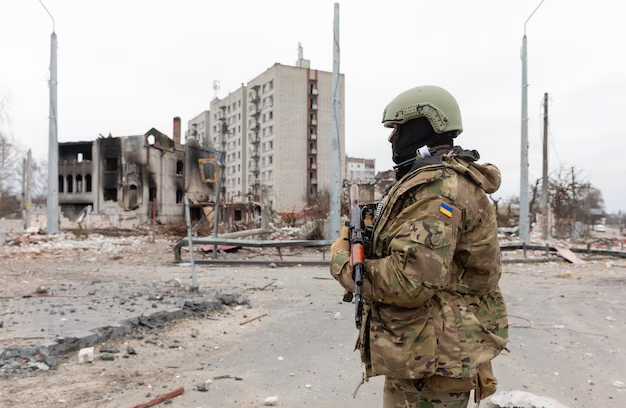
Few areas of world news carry higher stakes than conflict and security. Wars displace millions, reshape borders, shift alliances, and reorder the global economy. Terrorism, cyberattacks, and arms proliferation create threats that cross boundaries without warning. Yet the events that dominate headlines are rarely as simple as they appear — and understanding them requires more than knowing who is fighting whom.
This page explains what the conflict and security field actually covers, how analysts and researchers think about these issues, and what shapes outcomes in armed conflict, peacekeeping, and national security policy. Whether you are trying to understand a war currently underway, assess a region's stability, or make sense of what international institutions actually do, this is where to start.
🌍 Conflict and security sits within the broader landscape of world news as the domain concerned with organized violence, the institutions built to prevent it, and the policies designed to protect populations and states from harm. It is distinct from political news in that its focus is on physical threats, military forces, and the systems — formal and informal — that either contain or accelerate violence.
This sub-category covers a wide spectrum: interstate wars (conflicts between sovereign nations), intrastate or civil wars (armed conflict within a country's borders), insurgencies, terrorism, genocide and mass atrocities, nuclear and conventional arms proliferation, cybersecurity threats with national security implications, and the international frameworks — treaties, alliances, peacekeeping missions — designed to manage all of the above.
The distinction matters because the analytical tools that apply to, say, an election dispute differ significantly from those needed to assess a military offensive or a sanctions regime. Security analysis draws on military doctrine, international law, historical precedent, intelligence assessment, and political economy simultaneously.
Security researchers generally identify several recurring drivers of armed conflict. Structural factors — such as competition over territory, resources, or political power — often create the underlying conditions. Proximate triggers — a political assassination, an election dispute, a border incident — can ignite violence when those structural tensions are already high. Neither factor alone is typically sufficient; most large-scale conflicts involve both.
Escalation dynamics are among the most studied phenomena in conflict research. Once violence begins, each side's responses are shaped by perceived threats, sunk costs, domestic political pressures, and the involvement of outside actors. Research consistently shows that third-party interventions — whether military, diplomatic, or economic — can either dampen or intensify conflict depending on timing, form, and the interests of the intervening parties. The evidence on which types of intervention produce durable outcomes is genuinely mixed, and researchers continue to debate it.
How conflicts end is equally complex. Most modern conflicts do not end with clear military victory for one side. Studies of post-1945 conflicts suggest that negotiated settlements, ceasefires, and mediated agreements are more common outcomes than outright military defeat — though many settlements are fragile, and relapse into violence is a documented risk, particularly in the years immediately following a ceasefire.
Understanding conflict and security reporting is easier with a working vocabulary of core terms.
Deterrence refers to the strategy of preventing an adversary from taking a hostile action by making the costs of that action unacceptably high. Nuclear deterrence — the idea that the threat of catastrophic retaliation prevents nuclear war — has defined great-power relations since the mid-20th century, though analysts continue to debate its stability under different conditions.
Hybrid warfare describes conflicts that blend conventional military action with cyberattacks, disinformation campaigns, economic coercion, and the use of proxy forces — often in ways designed to create ambiguity about who is responsible. It has become a central concept in analyzing contemporary conflicts involving major powers.
Non-state armed groups — including insurgent movements, militias, and terrorist organizations — now play a central role in many of the world's active conflicts. Their goals, internal structures, and relationships with state actors vary enormously, which shapes how conflicts involving them unfold and how they might be resolved.
Sanctions are economic or diplomatic penalties imposed by one country or a coalition on another, typically as a coercive tool short of military force. Research on their effectiveness is mixed: sanctions appear more likely to achieve limited, targeted goals than to force broad behavioral change from governments with strong domestic support or alternative trading partners.
Peacekeeping and peacebuilding are distinct activities often conflated in public discussion. Peacekeeping typically involves deploying neutral forces to monitor and maintain a ceasefire already in place. Peacebuilding is the longer-term effort to address the conditions that caused the conflict — institutional reform, economic development, reconciliation — and is generally considered harder to sustain.
⚖️ No two conflicts or security situations are identical, and outcomes depend on a web of intersecting factors. Understanding those factors is what distinguishes careful security analysis from surface-level reporting.
| Factor | Why It Matters |
|---|---|
| Geography and terrain | Affects military strategy, supply lines, and which parties have tactical advantages |
| External actors | Third-party support — financial, military, diplomatic — can significantly alter the balance of power |
| Governance quality | States with weak institutions are both more prone to civil conflict and less capable of resolving it |
| Economic conditions | Resource wealth, poverty, and economic inequality are each associated with different conflict dynamics |
| Historical grievances | Long-standing ethnic, religious, or territorial disputes shape how conflicts begin and how hard they are to resolve |
| Information environment | Disinformation and propaganda influence domestic support for war and international perceptions of legitimacy |
| International law and norms | Whether parties perceive legal or reputational costs for their actions affects behavior, though enforcement varies widely |
These variables interact. A fragile state with significant natural resources, external powers competing for influence, and a history of unresolved grievances faces a very different risk profile than a stable democracy with a defensive alliance network. Analysts weigh these factors in combination — which is why security assessments from credible experts rarely reduce to simple predictions.
Security situations do not fall neatly into "war" or "peace." Researchers and policymakers increasingly think in terms of a conflict spectrum: from latent tension and political instability, through low-level violence and insurgency, to full-scale conventional warfare, and including the gray zones of hybrid conflict where the threshold of war is deliberately blurred.
Where a situation sits on this spectrum matters for how journalists cover it, how governments respond, and what international bodies can do. A situation of persistent low-level violence that never quite reaches the threshold of declared war can still cause mass civilian casualties, economic collapse, and regional destabilization — as decades of research on so-called "frozen conflicts" illustrates.
Nuclear weapons introduce a distinct dimension. The existence of nuclear-armed states creates strategic constraints that do not apply to conventional conflicts. Analysts track not just the existence of nuclear arsenals but delivery systems, command-and-control structures, and the conditions under which nuclear use might be considered — areas where evidence is necessarily limited and where expert opinion varies.
🔍 Several distinct areas within this sub-category demand their own analysis, and each carries its own body of research and expert debate.
Terrorism and counterterrorism involve the study of political violence by non-state actors and the policy responses governments adopt. Research has examined the conditions that radicalize individuals, the organizational structures that sustain terrorist groups, and the effectiveness — and documented risks — of various counterterrorism strategies, including military operations, deradicalization programs, and legal prosecution.
Arms control and proliferation covers international efforts to limit the spread of weapons — particularly nuclear, biological, and chemical weapons — and the treaties, verification regimes, and diplomatic mechanisms that underpin those efforts. The durability of existing arms control frameworks has come under significant scrutiny in recent years as major powers have withdrawn from or failed to renew key agreements.
Cybersecurity as a national security domain has grown substantially as a focus of both government policy and research. The challenge of attribution — determining who is responsible for a cyberattack — and the absence of well-established international norms governing state behavior in cyberspace make this one of the more contested areas in current security studies.
Humanitarian law and civilian protection concerns the rules that govern how wars are fought — the laws of armed conflict, protections for civilians and non-combatants, and the bodies charged with monitoring violations. The gap between what international humanitarian law requires and what actually happens in active conflicts is a persistent and well-documented concern in this field.
Regional security dynamics — in Europe, the Middle East, East Asia, Africa, and beyond — each carry distinct histories, alliance structures, and threat profiles. Events that appear similar on the surface (a border dispute, a coup, a sanctions regime) can have very different implications depending on the regional context. Coverage that strips away that context tends to mislead more than it informs.
Understanding any of these areas requires grappling with incomplete information, contested interpretations, and the limits of what researchers can establish with confidence. That uncertainty is not a failure of the field — it reflects the genuine complexity of the subject matter, and responsible analysis names it rather than concealing it.